
Do I Need a Permit?
Free county-by-county permit lookup for land clearing and tree removal in Kentucky, Ohio, and Indiana.
Check Your County
Select your state and county to see local permit requirements for land clearing and tree removal projects.
Select Your State
Choose the state where your property is located
General Guidelines
These rules apply across Kentucky, Ohio, and Indiana regardless of your specific county.
You ALWAYS Need a Permit For
- •Clearing in FEMA-mapped floodplains — requires a floodplain development permit from your county.
- •Disturbing wetlands — requires a U.S. Army Corps of Engineers Section 404 permit and state certification.
- •Clearing near endangered species habitat — Indiana bat, for example, may restrict clearing during roosting season (April-October).
- •Land disturbance over 1 acre — triggers NPDES stormwater permits in all three states (KY, OH, IN).
- •Removing trees within most city limits — many municipalities have tree preservation or removal ordinances.
- •Clearing on public land or government right-of-way.
You Typically DON'T Need a Permit For
- •Clearing trees on private residential land in unincorporated rural areas (KY and IN especially).
- •Removing dead, dying, or hazardous trees that pose a safety risk to structures or people.
- •Agricultural land clearing — farming operations are broadly exempt in all three states.
- •Brush hogging, mowing, or clearing undergrowth that does not involve removing established trees.
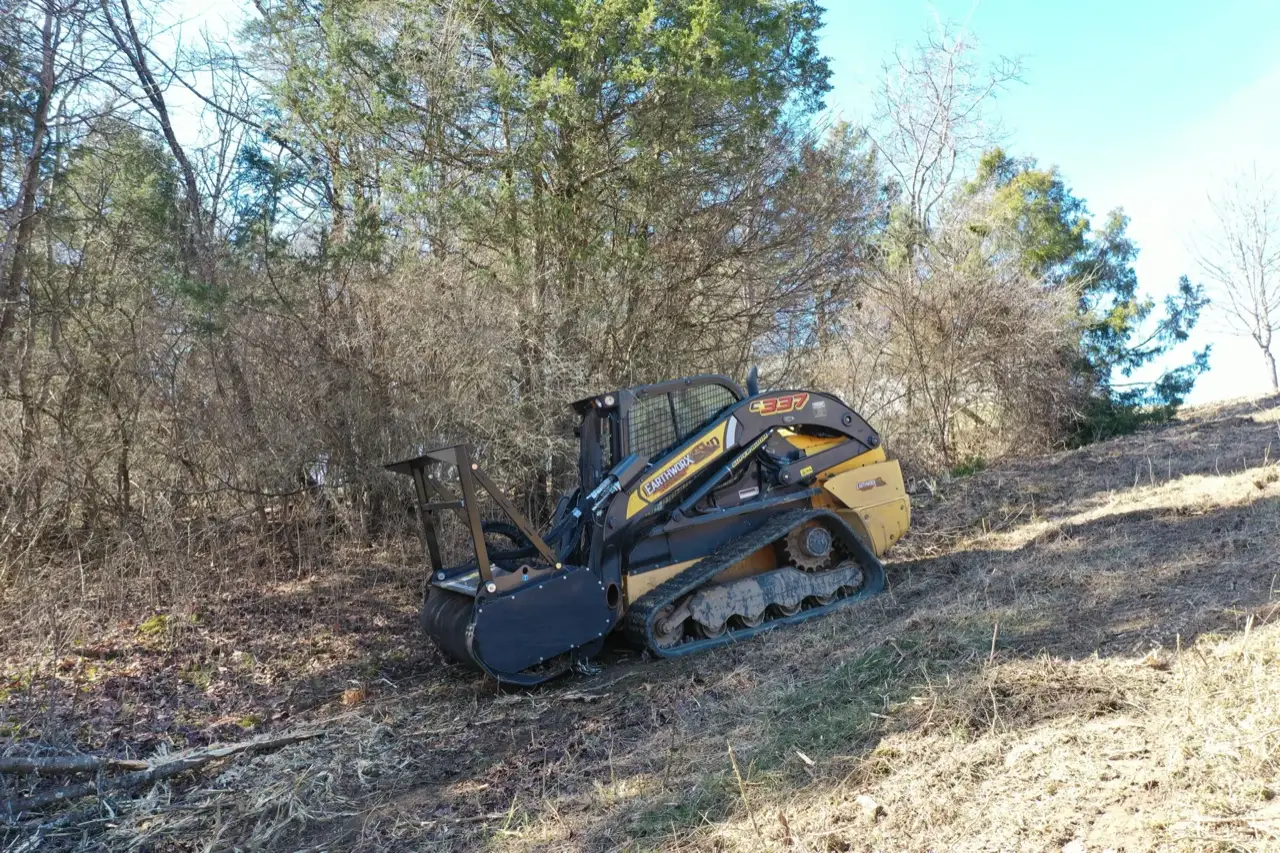
- •Forestry mulching on private rural property — no burn permits, no haul permits needed.
- •Clearing for fence lines, driveways, or utility access on your own property (outside city limits).
Disclaimer: This information is provided as general guidance and does not constitute legal advice. Regulations change and may vary by municipality. Always confirm current requirements with your local planning or zoning office before beginning any clearing project. EarthWorx is happy to help — call us at (859) 710-6107 and we will verify the requirements for your specific property.
Forestry Mulching Simplifies Permits
No Burn Permits
Forestry mulching processes debris on-site. No open burning means no burn permits, no smoke complaints, and no air quality concerns.
No Haul Permits
Mulch stays on the ground as a natural erosion barrier. No trucks hauling debris means no overweight permits or landfill fees.
Built-In Erosion Control
The mulch layer left behind prevents erosion naturally, which can satisfy stormwater management requirements in many jurisdictions.
Minimal Ground Disturbance
Unlike bulldozing, forestry mulching does not scrape topsoil. This often avoids triggering grading permit requirements.
We Handle Paperwork
When permits are required, our team manages the entire process — applications, inspections, and compliance documentation.
Local Knowledge
We work in every county in our service area regularly. We know the planners, the rules, and the fastest way to get your project approved.
Permit FAQ
In most cases, no — especially in rural and unincorporated areas of Kentucky and Indiana. However, some cities and municipalities (particularly in Ohio) have tree preservation ordinances that require permits even on private residential land. The rules depend on your county, whether you are inside city limits, and the scope of the project. Use our lookup tool above to check your specific county.
Floodplain clearing almost always requires permits regardless of your county or state. FEMA-mapped floodplains are regulated at the federal, state, and local level. You will typically need a floodplain development permit from your county, and may also need Army Corps of Engineers and state environmental agency approvals. EarthWorx can help you determine if your property is in a floodplain and guide you through the permitting process.
Yes. When permits are required, we handle the process from start to finish. We know the local planning departments, understand the regulations in every county we serve, and will make sure your project is fully compliant before any equipment touches the ground. This is included as part of our project planning — no extra charge for the legwork.
Yes, and they can be significant. Penalties vary by jurisdiction but may include fines, stop-work orders, required replanting at your expense, and even legal action. In some Ohio municipalities, fines can reach $500 or more per tree removed without a permit. Clearing in wetlands without federal permits can result in fines of up to $25,000 per day. It is always cheaper to get the permit first.
Forestry mulching itself does not have a separate permit category — the same tree removal and land clearing regulations apply regardless of the method used. The advantage of forestry mulching is that it does not require burn permits (no burning involved), haul permits (debris stays on-site as mulch), or separate erosion control since the mulch layer prevents erosion naturally.
We Handle the Permits
Not sure about the rules for your property? Call us. We will check the regulations, handle the paperwork, and get your project cleared to start.
Try our cost calculator · Serving Northern Kentucky, Greater Cincinnati, and Southeast Indiana · 24/7 — Emergency Service Available