
Multiflora Rose Removal: A Practical Guide for Ohio & Kentucky Property Owners
Multiflora rose has claimed more fence rows in Kentucky and Ohio than any other plant. Here is how to actually get rid of it, not just bleed for a weekend trying.
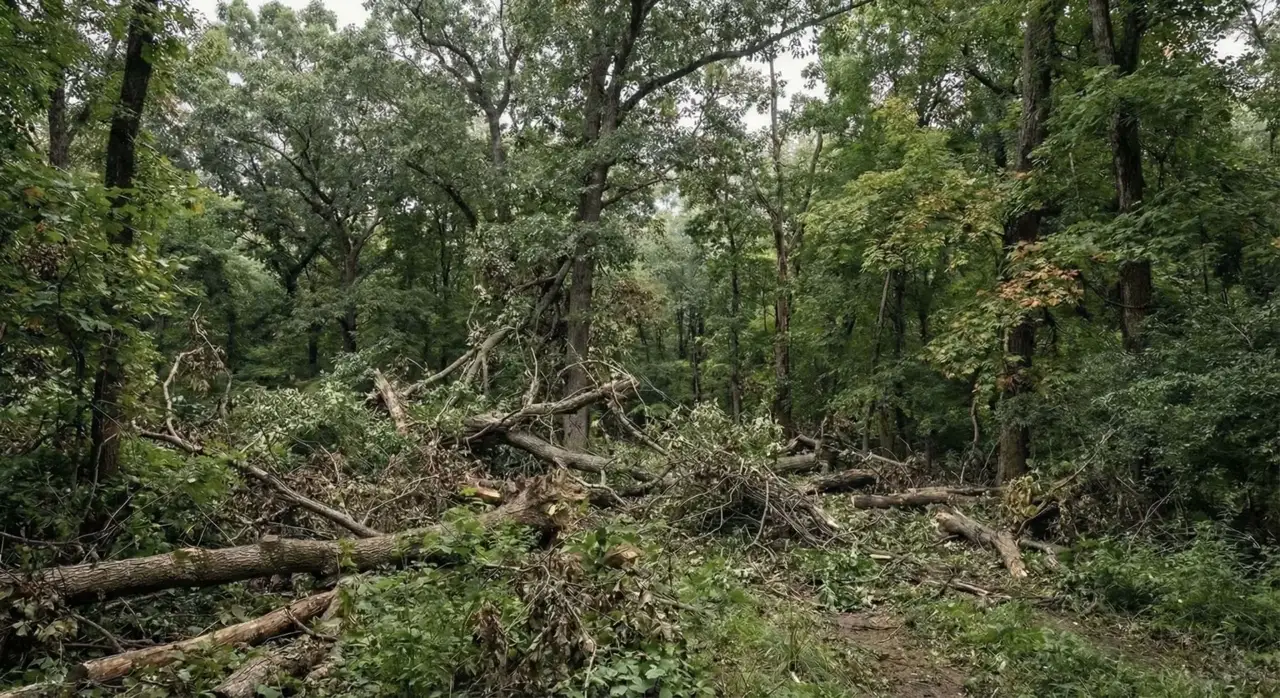
Multiflora rose removal on large properties is most effective with forestry mulching, which grinds the thorny canes and root crowns into mulch in one pass. Follow up with herbicide (triclopyr or glyphosate) on resprouts 4 to 8 weeks later. Cost runs $1,500 to $3,500 per acre depending on density. Hand removal is impractical for areas larger than a quarter acre due to the extreme thorns and dense growth habit.
The Thorny Problem Nobody Wants to Deal With
There is a reason multiflora rose (Rosa multiflora) is the plant that property owners dread the most. It is not the fastest spreader or the tallest grower. It is the thorns. Curved, fish-hook thorns on every single cane that grab clothing, skin, gloves, and equipment and do not let go. Working in multiflora rose with hand tools means coming home looking like you lost a fight with a bobcat.
We see it on almost every property we visit in Kenton County, Campbell County, and across the river in the Greater Cincinnati area. It loves fence rows. It lives in pasture margins. It crawls into woodlots. And once it gets established, the arching canes root where they touch the ground, creating an expanding thicket that can swallow a fence line in three or four years.
Like autumn olive, multiflora rose was introduced on purpose. The USDA promoted it as a living fence and erosion control plant from the 1930s through the 1960s. Some highway departments planted it along road medians. That worked out about as well as you would expect. It jumped the fence rows and never looked back.
Identifying Multiflora Rose
You probably already know what it looks like if you have walked through it. But for the record:
- Canes: Arching green to reddish-brown stems covered in curved thorns. Canes can grow 10 to 15 feet long in a single season.
- Leaves: Compound leaves with 5 to 11 small leaflets, each with toothed edges. A fringed stipule at the base of each leaf stalk is the giveaway. Native roses have smooth stipules.
- Flowers: Small white flowers in clusters, blooming in May and June. Pretty, if you forget what the plant does the other 11 months.
- Hips: Small red rose hips in fall and winter. Birds eat them and spread seeds across the county.
- Rooting canes: Where a cane arches over and touches the ground, it puts down roots and starts a new plant. One bush becomes a thicket this way.
The fringed stipule is the key identification feature. If you are looking at a thorny shrub and the small leaf-like structures at the base of each leaf stem have a feathery fringe, it is multiflora rose.
Why Hand Clearing Is Impractical for Large Areas
For a single bush in your garden, sure, put on heavy leather gloves, long sleeves, and safety glasses, and go after it with loppers and a mattock. Dig out the root crown. It will take you an hour per plant, and you will get scratched, but it is doable.
Now multiply that by a hundred. Or a thousand. That is what a half-acre fence row of multiflora rose looks like. The canes interlock and layer on top of each other. Dead canes from previous years create a mat underneath the live growth. The thorns grab everything. Chainsaws bind in the tangled canes. Brush cutters wrap up. Every piece you cut has to be dragged out of the thicket, and every piece fights you the whole way.
We have watched landowners spend entire weekends cutting a 50-foot section of fence row only to realize they have 600 feet left to go. And the 50 feet they cleared is already resprouting.
In our experience, hand clearing multiflora rose becomes impractical at about a quarter acre. Beyond that, the labor cost exceeds what a machine would charge, and the machine does a better job.
The Mulching Approach
A forestry mulcher handles multiflora rose the same way it handles any woody brush. The rotating drum with carbide teeth grinds the canes, root crowns, and even the rooted tip layers into wood chips. The thorns that make hand work miserable are irrelevant to a machine spinning at 2,000 RPM.
The key difference between mulching multiflora rose and mulching other species is the density. A solid multiflora rose thicket is one of the densest vegetation types we encounter. The interlocked canes create a mass that the mulcher has to work through slowly, grinding from the top down and feeding material into the drum gradually. Trying to drive straight into a head-high wall of multiflora rose stalls the drum. We work it in layers.
On a typical fence row clearing job in Kenton County where multiflora rose has taken over both sides of the fence, we clear at about 200 to 300 linear feet per hour. That includes grinding the rose, the fence posts and wire it has grown through (we remove metal fencing first when possible), and any trees growing in the line.
What About the Old Fence?
This comes up on nearly every fence row job. The multiflora rose has grown through and around the old wire fence to the point where you cannot separate the two. Metal in the mulcher is bad. Wire wraps around the drum and teeth. T-posts can crack the housing.
We walk the fence line before mulching and pull out as much metal as we can. Old barbed wire that is grown into trees or buried under rose canes gets clipped and pulled section by section. It adds time to the job, but it saves the equipment. If the fence is in bad enough shape that it cannot be salvaged, we work with the landowner to decide whether to remove it entirely or mulch up to it and let a fence crew replace it after.
Timing for Multiflora Rose Removal
Multiflora rose can be mulched any time of year, but timing affects regrowth.
- Late spring to early summer (May-July): Best window. The plant is using stored root energy to produce new canes and leaves. Removing the top growth at this point causes the most stress on the root system. Follow-up herbicide 6 to 8 weeks later catches regrowth during active growth.
- Late summer to fall (August-October): The plant is producing rose hips. Mulching at this point removes the current seed crop, which is a secondary benefit. Herbicide follow-up in fall still works but translocation to roots is slightly less effective than mid-summer.
- Winter (November-March): The machine works well on frozen ground, and the dormant canes are slightly less dense without leaves. But the root system has full energy reserves, so regrowth the following spring will be stronger. Plan for earlier and possibly repeated herbicide follow-up.
Herbicide Follow-Up for Regrowth Prevention
Just like autumn olive, multiflora rose will resprout from the root crown after mulching. The mulch layer slows it down but does not prevent it entirely. Herbicide follow-up is the second half of the treatment.
For multiflora rose resprouts, triclopyr-based herbicides (Crossbow, Garlon 4) work well. Apply as a foliar spray at 2% concentration with surfactant when resprouts are 12 to 18 inches tall. This is usually 4 to 8 weeks after mulching depending on the time of year.
Glyphosate (Roundup) works too but is non-selective, meaning it kills everything it touches. In a fence row where you want native grasses to fill in, triclopyr is the better choice because it does not harm grasses.
Expect to do one follow-up treatment the first year and possibly a spot treatment the second year. By year three, surviving rose plants are rare if the initial mulching and herbicide were done during the right window.
Realistic Cost for Multiflora Rose Removal
| Job Type | Typical Cost | Notes |
|---|---|---|
| Fence row clearing (per 100 linear feet) | $300-$600 | Both sides of the fence, includes metal removal |
| Pasture edge clearing (per acre) | $1,500-$2,500 | Mixed rose and other brush |
| Solid rose thicket (per acre) | $2,500-$3,500 | Dense, interlocked canes, slow going |
| Herbicide follow-up (per acre) | $200-$500 | Foliar spray on resprouts |
Fence row jobs are priced by linear footage rather than acreage because the work area is narrow. A 1,000-foot fence row clearing with multiflora rose on both sides typically runs $3,000 to $5,000 including metal removal and herbicide follow-up.
What to Plant After Removal
Once the multiflora rose is gone and the herbicide follow-up is complete, you have a window to establish competing vegetation. Nature fills bare ground fast in this climate, and if you do not put something there on purpose, you will get whatever blows in. Often that means more invasive species.
For fence rows, native grass mixes work well. Big bluestem, indiangrass, and switchgrass establish thick root systems that compete with rose seedlings. These warm-season grasses also provide better habitat than the rose thicket they replaced.
For pasture areas, a standard fescue or orchard grass seeding fills in within one growing season when seeded into the mulch layer. The mulch retains moisture and gives the seed a good germination bed. We have seen former rose thickets in the Cincinnati area turn into productive pasture within two years of treatment.
When Professional Removal Makes Sense
A few scattered multiflora rose bushes in your yard are a hand-tool job. Get the loppers, dig the roots, and move on with your day.
But if your fence rows have disappeared into rose thickets, or your back acreage is turning into an impenetrable wall of thorns, a forestry mulcher gets through it in hours instead of weeks. EarthWorx clears multiflora rose across the greater Cincinnati and Northern Kentucky area. Get a free estimate — we know what we are walking into on these jobs, and we bring the right equipment for it.
Related Services
We Serve These Areas
Multiflora Rose Removal: A Practical Guide for Ohio & Kentucky Property Owners FAQ
No. Multiflora rose resprouts aggressively from the root crown after cutting. Cut plants typically send up more stems than they had before. Effective removal requires killing the root system with herbicide applied to the resprouts 4 to 8 weeks after cutting or mulching.
Triclopyr-based herbicides (Crossbow, Garlon 4) are the best choice for multiflora rose because they kill broadleaf plants without harming grasses. Apply at 2% concentration as a foliar spray on resprouts. Glyphosate also works but kills grasses too, making it less ideal for fence row or pasture settings.
A single multiflora rose plant can produce up to 500,000 seeds per year, spread by birds and small mammals. The arching canes also root where they touch the ground, expanding the thicket outward 2 to 4 feet per year. An untreated plant can colonize a 20-foot diameter area within 5 years.
Yes. Multiflora rose is listed as invasive in both Ohio and Kentucky. It was introduced by the USDA as a living fence plant in the 1930s through 1960s and has since escaped cultivation to become one of the most common invasive shrubs in the region.
Professional removal by forestry mulching costs $1,500 to $3,500 per acre depending on density, plus $200 to $500 per acre for herbicide follow-up. Fence row clearing runs $300 to $600 per 100 linear feet. Dense thickets cost more due to slower machine speed.
Ready to Get Started?
Free on-site estimates for all properties in our service area.
Ready to Clear Your Land?
Get a free, no-obligation estimate for your project. We respond fast and show up on time.
Try our cost calculator · Serving Northern Kentucky, Greater Cincinnati, and Southeast Indiana · 24/7 — Emergency Service Available