
Land Clearing for New Home Construction: A Step-by-Step Guide
The full process of turning raw land into a buildable lot in Northern Kentucky — from initial clearing through grading, driveway, and utility prep, with real costs and timelines.
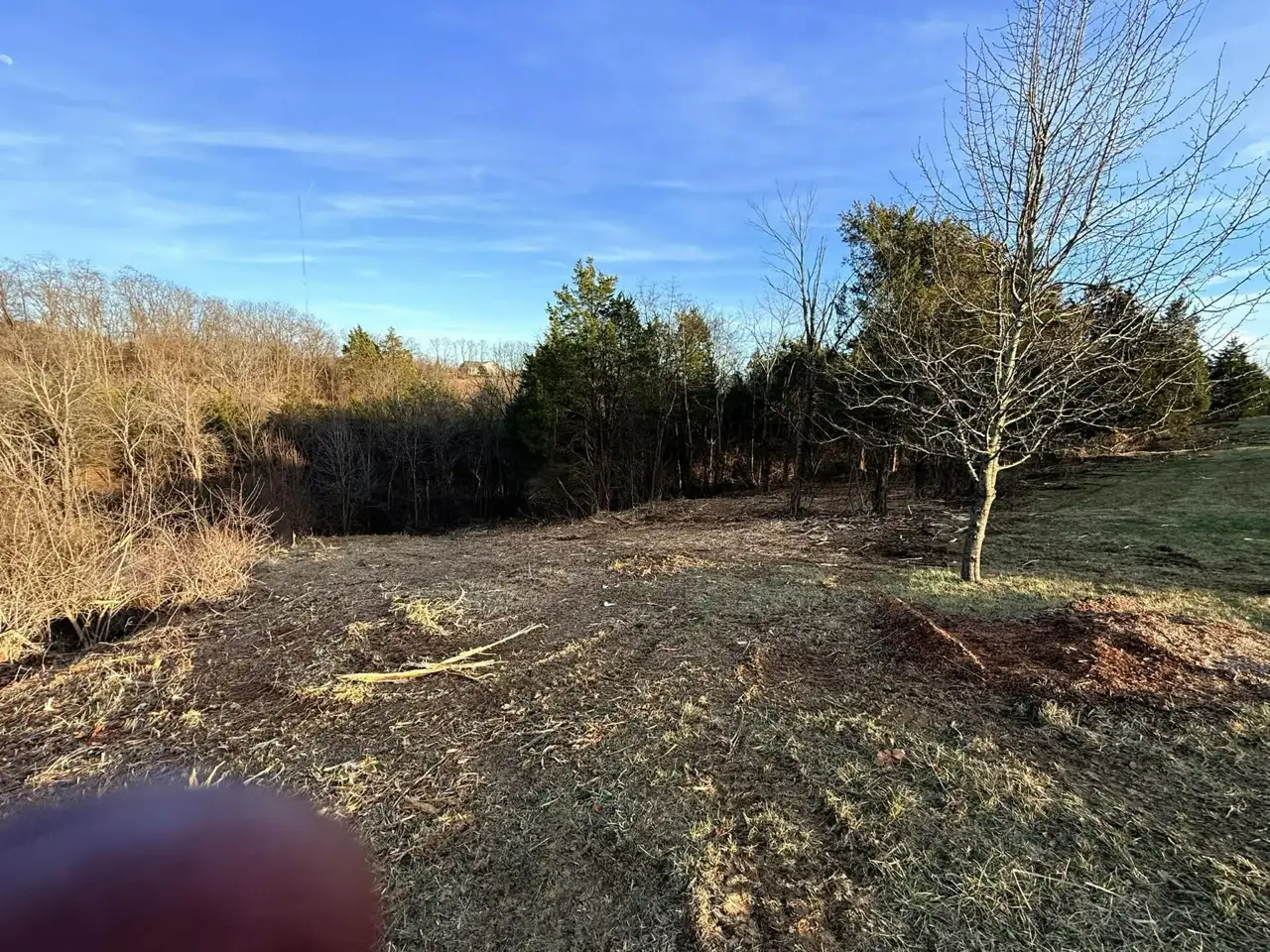
Land clearing for new home construction involves site survey, tree removal, brush clearing, stump removal, grading to establish drainage and a building pad, driveway installation, and utility trenching. The full process takes 2–6 weeks and costs $8,000–$30,000+ for a typical 1–3 acre lot in Northern Kentucky depending on vegetation density and site work required.
You Bought Raw Land. Now What?
Congratulations — you own a piece of dirt. Or, more likely, you own a piece of dirt covered in trees, brush, honeysuckle, and maybe a rusted-out truck someone abandoned in 1987. The gap between "I bought land" and "my builder can start" is bigger than most people realize, and residential lot clearing is where we come in.
We do this work across Northern Kentucky and Greater Cincinnati year-round. I've walked hundreds of raw lots with first-time landowners who had no idea what was involved in turning their wooded acre into a home site. This guide walks through every step in the order things actually happen.
Step 1: Survey and Planning
Before anyone touches a tree, you need a property survey. If you don't already have one from the purchase, hire a surveyor. Costs run $400–$800 for a standard residential lot in NKY. You need to know exactly where your property lines are, where setbacks fall, and where the house pad will sit.
Your builder or architect should have a site plan by this point showing the house location, driveway, septic field (if applicable), and any outbuildings. We use this plan to determine what gets cleared and what stays.
Talk to your county first. Boone County, Kenton County, and Campbell County all have different requirements for new construction on raw land. Some areas require erosion control plans before any clearing starts. Independence, Georgetown, and some Kenton County subdivisions have tree preservation ordinances. Find this out before you spend money clearing trees you weren't allowed to remove.
Step 2: Utility Locates and Underground Assessment
Call 811 at least a week before any work starts. This is free and is required by Kentucky and Ohio law. They'll mark any existing underground utilities — gas, electric, water, telecom, sewer. Even if you think the property is completely undeveloped, there may be old utility lines running through it from a previous structure or a neighboring property.
If you're on a lot that's been wooded for decades, there could be old well casings, cisterns, septic tanks, or buried foundations. We've found all of these on properties in Pendleton and Grant County. Knowing what's down there before the mulcher rolls across it matters.
Step 3: Selective Clearing vs. Full Clearing
This is the first real decision you'll make, and it affects both cost and the long-term feel of your property.
Full Clearing
Every tree, bush, and stump comes out. The lot is taken down to bare ground. This is typical when the entire parcel is the building site and you need maximum flexibility for house placement, septic, and driveway.
Cost: $3,000–$6,000 per acre depending on vegetation. A 1.5-acre lot in Independence with medium-density trees and brush might run $6,000–$10,000 for full clearing.
Selective Clearing
You keep certain trees — usually mature hardwoods in good shape — and clear everything around them. This costs more per acre because the operator has to work around the keepers, but you end up with a property that doesn't look like it was just bulldozed. Big oaks and maples add real value to a home site. A mature shade tree can add $5,000–$15,000 to property value according to most appraisals.
We flag the keepers with ribbon before starting. If you want to save that 20-inch white oak near where the back deck will be, tell us during the estimate walk, not after we've already cleared past it.
Our Recommendation
We almost always recommend selective clearing for home sites. A house on a bare lot looks like it was dropped there. A house with four or five mature trees around it looks like it belongs. Save the good trees. Clear the junk.
Step 4: Forestry Mulching and Brush Clearing
Once we know the plan, the mulcher goes to work. For a typical home construction lot, we're clearing everything in the building zone plus a buffer around it — usually 20–30 feet beyond the house footprint for construction access, grading, and drainage.
We also clear the driveway path from the road to the house site. If the lot is deep — say, the house is 300 feet off the road — that driveway corridor is a significant part of the clearing work.
Forestry mulching handles the brush and trees up to about 8–10 inches in diameter. Larger trees get felled by chainsaw first, then the mulcher processes the branches and smaller material. The logs from larger trees can be stacked on-site for firewood or hauled off.
Timeline: 1–3 days for most residential lots of 1–3 acres.
Step 5: Stump Removal
For a home construction site, stumps have to come out. Not just cut flush — actually removed or ground out 12–18 inches below grade. You can't pour a foundation over stumps, and you can't compact fill over them either. They rot over time, creating voids that cause settling.
Stump removal adds $3–$8 per inch of stump diameter or $100–$300 per stump depending on size. A lot with 30 stumps in the building zone might add $3,000–$6,000 to the project. This is the step people forget to budget for.
Outside the building pad and driveway, stumps can be left at ground level. They'll rot on their own over a few years.
Step 6: Grading
Now you've got a cleared lot with exposed ground. Grading is what turns it from "cleared" to "buildable."
The grading work includes:
- Building pad — A level area for the foundation, compacted to meet building code requirements. Your builder's engineer specs the size and elevation.
- Drainage — Water has to flow away from the house. In Northern Kentucky's clay soils, drainage is a big deal. Poor grading leads to wet basements. Period.
- Driveway base — The driveway gets rough-graded and a gravel base layer installed. Final paving or concrete comes later, usually after the house is framed.
- Utility trenches — Trenches for water, sewer (or septic lines), electric, and gas conduit. These get backfilled and compacted.
- Erosion control — Silt fencing, seeding exposed slopes, straw blankets. Required by most NKY counties before you can get a building permit.
Grading cost: $3,000–$12,000 depending on the size of the pad, how much fill or cut is needed, and the terrain. A relatively flat lot in West Chester is a different job than a sloped lot off Hwy 17 in Grant County.
Step 7: Driveway Installation
Most NKY lots use gravel driveways during construction, with paving or concrete added after the build. This makes sense because heavy construction traffic — concrete trucks, lumber deliveries, excavators — tears up finished surfaces.
A basic gravel driveway runs $12–$25 per linear foot for a 12-foot-wide drive. If your house is 200 feet off the road, that's $2,400–$5,000 for the initial gravel drive. Steeper grades cost more because they need more gravel and drainage features like water bars or culverts.
If the property is off a county road, you'll need a driveway permit from the county. If it's off a state road, you need a permit from KYTC (Kentucky Transportation Cabinet) or ODOT on the Ohio side. These take 2–6 weeks.
Step 8: Utility Connections
This varies a lot by location. In a subdivision near Independence or Florence, utilities are usually at the road. You're connecting, not installing from scratch. In rural Grant County or Pendleton County, you might be running electric 500 feet from the transformer and drilling a well because there's no water line.
- Water tap fee: $500–$2,500 in NKY
- Sewer tap fee: $1,000–$5,000
- Septic system (if no sewer): $8,000–$15,000
- Electric service: $500–$3,000 depending on distance from transformer
- Gas service: $500–$2,000 if available
Utility costs are outside our scope, but I mention them because they're part of the total land-to-buildable budget. People who only budget for clearing and grading get surprised by the utility connection costs.
Total Cost: Clearing Through Build-Ready
Here's what the full process typically costs for a 1–3 acre lot in our area.
| Item | Cost Range |
|---|---|
| Survey | $400–$800 |
| Clearing (forestry mulching) | $3,000–$12,000 |
| Stump removal (building zone) | $2,000–$6,000 |
| Grading and building pad | $3,000–$12,000 |
| Driveway (gravel, initial) | $2,000–$5,000 |
| Erosion control | $500–$2,000 |
| Utility connections | $3,000–$15,000+ |
| Total | $14,000–$53,000+ |
That's a wide range, and your project will land somewhere specific within it. A flat 1-acre lot near Independence with utilities at the road is going to be on the low end. A steep 3-acre wooded lot in rural Grant County with well and septic is going to be on the high end.
Timeline: How Long All of This Takes
Here's a realistic timeline. Not the best-case scenario, but what we actually see on projects.
| Phase | Duration |
|---|---|
| Survey and permits | 2–4 weeks |
| 811 utility locate | 3–5 business days |
| Clearing and mulching | 1–3 days |
| Stump removal | 1–2 days |
| Grading | 2–5 days |
| Driveway | 1–2 days |
| Erosion control and seeding | 1 day |
| Total | 4–8 weeks |
The calendar time is longer than the work time because of scheduling gaps between phases and weather delays. Northern Kentucky clay turns into a muddy mess after heavy rain, and grading work can't happen when the ground is saturated. If you're starting in spring, build in buffer time for weather delays.
Mistakes That Cost Homeowners Money
We've seen these enough times to list them.
- Not getting a survey first. Clearing trees on your neighbor's property is an expensive mistake. Know your lines.
- Clearing before the site plan is final. If the house location moves 30 feet after clearing, you may have removed trees you could have saved and left trees in the new footprint.
- Skipping stump removal in the building zone. Your builder will find them during excavation and charge you to deal with them. It's cheaper to handle stumps during the clearing phase.
- Ignoring drainage. NKY clay does not drain well. Grading that doesn't account for water management is grading you'll pay to redo.
- Clearing in spring without erosion control. Spring rains on exposed clay create washouts and can get you fined by the county.
Working with Your Builder
Ideally, your builder is involved before clearing starts. They can tell us exactly what they need — pad elevation, driveway grade, utility trench locations. When we coordinate directly with the builder, the handoff between site prep and construction is smooth.
If you haven't selected a builder yet, that's fine. We can do a general clearing that gives any builder a workable starting point. But if you already have a builder, get us talking to each other early. It saves time and money.
Get Your Land Ready
Call us at (859) 710-6107 for a free site walk and estimate. We handle everything from initial clearing through grading and driveway prep. We work with your builder, your surveyor, and the county to make the process as straightforward as possible.
Bring your site plan if you have one, or just bring the address. We'll walk the property and give you a realistic budget and timeline.
Related Services
We Serve These Areas
Land Clearing for New Home Construction: A Step-by-Step Guide FAQ
Clearing a 1–3 acre lot for new home construction in Northern Kentucky typically costs $3,000–$12,000 for the clearing alone. Adding stump removal, grading, driveway, and utility prep brings the total site work to $14,000–$53,000+ depending on lot size, terrain, and utility availability.
The physical work — clearing, stump removal, grading, and driveway — takes about 1–2 weeks. Including permits, surveys, utility locates, and weather delays, expect 4–8 weeks from start to build-ready. Spring projects should allow extra time for rain delays on clay soils.
Requirements vary by county. Boone, Kenton, and Campbell counties typically require erosion control plans and sometimes tree preservation compliance before clearing. Rural areas like Grant and Pendleton counties have fewer restrictions. Check with your county planning office before clearing.
It is best to have your builder involved before clearing begins so the site plan determines what is cleared. If your builder is not yet selected, a general clearing can provide a workable starting point, but coordinating with the builder upfront avoids re-work and extra cost.
Yes. Selective clearing preserves mature trees you want to keep while removing everything else. We flag keeper trees before starting. Mature hardwoods can add $5,000–$15,000 to property value and provide shade that reduces energy costs. The trade-off is that selective clearing costs more per acre than full clearing.
Clearing removes vegetation — trees, brush, and stumps. Grading shapes the ground to create a level building pad, establish drainage, and prepare the driveway base. They are separate operations with different equipment. Most home construction sites need both.
Ready to Get Started?
Free on-site estimates for all properties in our service area.
Ready to Clear Your Land?
Get a free, no-obligation estimate for your project. We respond fast and show up on time.
Try our cost calculator · Serving Northern Kentucky, Greater Cincinnati, and Southeast Indiana · 24/7 — Emergency Service Available