
How Much Does Forestry Mulching Cost? 2025 Pricing Guide
A straight breakdown of forestry mulching costs per hour and per acre in the NKY/Cincinnati area, with real numbers from jobs we have actually done.
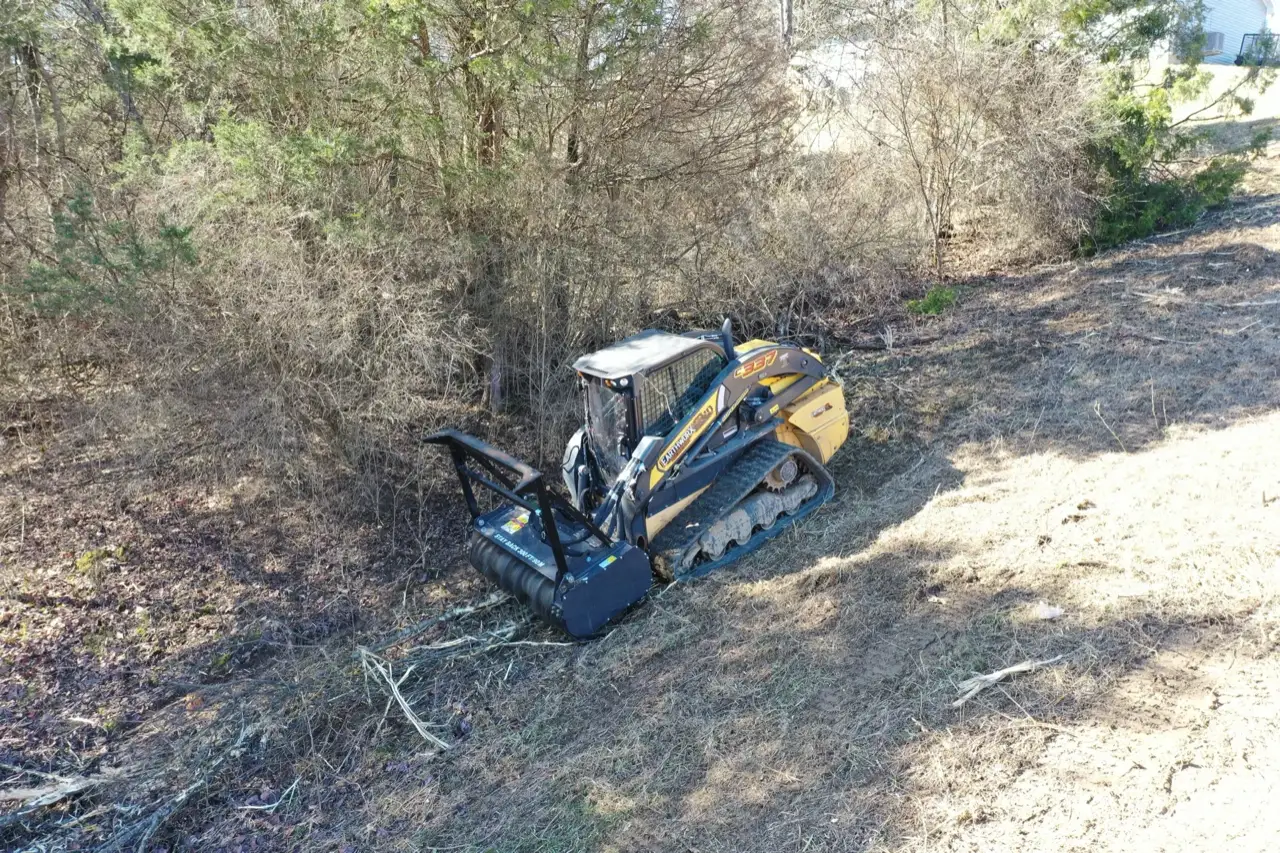
Forestry mulching costs $150 to $500 per hour or $1,500 to $5,000 per acre in the Northern Kentucky and Greater Cincinnati area. Light brush and saplings fall on the low end. Heavy hardwoods on steep terrain push toward the high end. Mobilization minimums, access, and vegetation density are the biggest price drivers.
The Quick Answer
Most people land on this page wanting one number. Here it is: forestry mulching in the Northern Kentucky and Greater Cincinnati market runs $150 to $500 per hour or roughly $1,500 to $5,000 per acre. That is a wide range. I know. But a flat half-acre of scrubby cedar is a totally different job than a steep hillside full of 10-inch hackberry and walls of multiflora rose.
We price by what the machine is actually chewing through, not some generic formula we pulled off the internet. Anyone who quotes you a hard per-acre number over the phone without seeing the property is guessing. And their guess is going to be wrong in one direction or the other.
What Actually Determines the Price
Vegetation Density and Tree Size
This is the single biggest factor. It is not close. Our mulching head handles trees up to about 8 to 10 inches in diameter efficiently. Anything bigger, and we are either making multiple passes or sending a chainsaw crew in first to drop the big stems. That pre-cut step adds labor and cost.
A thicket of honeysuckle that has been growing unchecked for a decade is cheaper to mulch than a stand of mature maples. The wood is softer, the stems are smaller, and the machine moves through it faster.
| Vegetation Type | Per-Acre Cost | Per-Hour Rate | Notes |
|---|---|---|---|
| Light brush, saplings under 4" | $1,500–$2,500 | $150–$250/hr | Fastest work, fewest passes |
| Medium brush with trees 4–8" | $2,500–$4,000 | $250–$400/hr | Most common job type we see |
| Heavy hardwoods 8–12"+ | $4,000–$5,000+ | $350–$500/hr | May need pre-cut, multiple passes |
| Invasive thickets (honeysuckle, autumn olive) | $1,500–$3,500 | $150–$300/hr | Dense but soft, grinds fast |
Terrain and Slope
Flat ground is fast ground. Northern Kentucky is not known for flat ground. The hills between Dry Ridge and Williamstown, the grades along the Licking River, the bluffs above the Ohio — all of that slows us down. Steep slopes mean more fuel burn, more wear on the machine, and more hours on-site.
If your property sits on a 25-degree grade above the river, it is going to cost more than the same acreage on a level field off US-25. That is just how it works. We are not padding the quote. The machine physically moves slower on slopes and the operator has to be more careful.
Access to the Property
Can we get a full-size forestry mulcher from the road to the work area without a problem? If the answer is yes, great. If the only way in is a narrow farm lane with a low bridge or a residential driveway with power lines on both sides, we need to plan around that. We have had jobs in Pendleton County where the access road added half a day just getting equipment positioned.
Things we need to know about before we show up: gates, overhead utility lines, septic systems, buried propane tanks, well heads. None of these kill the job. But they all change the approach.
What About Debris and Cleanup?
This is one of the big advantages of forestry mulching over other methods. Everything stays on-site as ground-up mulch. No hauling trucks, no burn piles, no dump fees. The mulched material breaks down over a year or two and actually helps with erosion control on slopes.
But if you need the mulch removed — say, for a building pad — or if there is existing junk in the woods (old fencing, concrete, scrap metal), that changes the scope. We have found everything from old car frames to buried well casings on properties. Surprises are part of the job.
Cost Factors Table: What Drives Price Up and Down
| Drives Price UP | Drives Price DOWN |
|---|---|
| Steep terrain (15°+ grade) | Flat ground with road access |
| Large diameter trees (8"+) | Light brush and small saplings |
| Poor or no equipment access | Clear path from road to work area |
| Rocky ground / limestone ledges | Clean soil without obstructions |
| Wet conditions / soft clay soil | Dry or frozen ground |
| Rush scheduling in peak season | Winter scheduling (Dec–Feb) |
| Small lot (under 0.5 acres) | Larger acreage (5+ acres) |
| Hidden debris (fencing, metal, concrete) | Clean woodland floor |
Regional Pricing in Our Service Area
Not all areas price the same, and the reasons are pretty straightforward.
| Region | Typical Per-Acre Range | Why |
|---|---|---|
| Northern Kentucky (Boone, Kenton, Campbell) | $1,500–$4,500 | Close to our base, good demand, mixed terrain |
| Greater Cincinnati suburbs (OH side) | $2,000–$5,000 | River crossing, urban access constraints |
| Grant, Pendleton, Owen counties | $1,800–$5,000 | More rural, larger parcels, varied vegetation |
| Southeast Indiana (Dearborn, Ohio Co.) | $3,000–$6,000 | Steeper terrain, longer drive, heavier timber |
| Florence / Burlington / Hebron corridor | $2,000–$4,500 | Residential lots, tight access, careful work near homes |
The SE Indiana premium is not because we charge more per hour there. The terrain along the Ohio River bluffs is genuinely harder to work. Steep, rocky, heavily wooded with mature hardwoods. The machine moves slower. And the drive from our shop in Demossville is longer, so mobilization eats more of the day.
Minimum Charges and Small Lots
Small jobs get expensive on a per-acre basis. We have a minimum charge of around $1,200 to $1,500 for any forestry mulching job, regardless of size. That covers loading the mulcher on a trailer, driving to your property, unloading, doing the work, reloading, and driving back.
A quarter-acre lot in Florence might take two hours of actual mulching. But the mobilization time is the same as a ten-acre job. So your effective per-acre rate on that small lot might hit $5,000 or more. We are not overcharging. The fixed costs just get divided across less work.
For small residential lots, sometimes a crew with chainsaws and a brush chipper is more cost-effective than bringing the big machine. We will tell you if that is the case. We would rather lose a mulching job and give you honest advice than take your money knowing there was a cheaper way.
Forestry Mulching vs. Alternatives: Honest Cost Comparison
People always ask how mulching compares to other clearing methods. Here is the real picture.
| Method | Per-Acre Cost | Hauling/Disposal | Topsoil Impact | Speed |
|---|---|---|---|---|
| Forestry mulching | $1,500–$5,000 | None — stays on-site as mulch | Minimal — topsoil stays intact | 1–3 acres/day typical |
| Bulldozer clearing | $2,000–$6,000 | $500–$2,000 extra | Severe — strips topsoil | Fast on flat ground |
| Chainsaw crew + chipping | $3,000–$8,000 | $300–$1,500 extra | Minimal | Slow — labor-intensive |
| Excavator with thumb | $2,500–$7,000 | $500–$2,000 extra | Moderate to severe | Good for mixed work |
When you add hauling costs, burn pile management, and topsoil damage into the bulldozer option, mulching usually comes out cheaper on the total project. And the site looks better afterward. A mulched property has an even layer of organic material on the ground instead of ruts, dirt piles, and ash.
What Is NOT Included in Our Quotes
This is where people get surprised. Better to cover it now.
- Stump grinding below grade — Our mulcher cuts stumps at or just below ground level. If you need them ground out 6 to 12 inches deep for a foundation, that is a separate machine and a separate charge.
- Grading or earthwork — Mulching removes vegetation. It does not level the ground. If you want a smooth buildable surface, grading is the next step.
- Erosion control seeding — On any slope, we strongly recommend hydroseeding or erosion blankets after mulching. We can do this. It is a separate line item.
- Herbicide follow-up for invasives — Mulching honeysuckle kills the top growth. The roots are still alive. Without a follow-up herbicide treatment 6 to 8 weeks later, most invasive species will resprout. We offer this service. It is not included in a standard mulching quote.
- Permits — Most rural properties in our area do not need clearing permits. But city limits, floodplains, and wetlands may have restrictions. That is on the landowner to check.
- 811 utility locates — Required by law before we start. Free service. Takes 3 to 5 business days. You need to call before we show up.
We are not always the cheapest option on paper. A guy with a dozer and a burn permit can clear an acre for less upfront. But you will end up with stumps, ruts, no topsoil, and a pile of ash where nothing will grow for a year. Forestry mulching leaves the ground intact, the organic matter working for you, and the property ready for whatever comes next. That matters.
How to Get an Accurate Quote From Us
The fastest path: call (859) 710-6107 and describe the property. We will schedule a site visit. We need to see the vegetation, walk the terrain, and check access before we give you a real number.
Google Earth helps for a first conversation but it does not show what is growing under the canopy. What looks like an open field from a satellite might be chest-high honeysuckle when you are standing in it.
Here is what to have ready when you call:
- Property address or GPS coordinates
- Approximate acreage you want cleared
- What is growing there (hardwoods, brush, invasives, mix of everything)
- What you plan to do with the land after it is cleared
- Any known obstacles (utilities, structures, fencing, septic)
- Your timeline — is this a sometime this year project or a need it done by March project?
Real Job Examples
5 acres off Hwy 17, Grant County — Former cattle pasture grown up in cedar, autumn olive, and multiflora rose over about 15 years. Relatively flat with one drainage swale. Two days of mulching. Total: $9,800 ($1,960/acre).
1.5 acres behind a house in Hebron — Dense honeysuckle and privet with scattered hackberry up to 8 inches. Tight access through a residential area, neighbor fence along one side. Careful work near structures. Total: $4,200 ($2,800/acre).
12 acres on a hillside in Pendleton County — Heavy mixed hardwoods on a 20-degree slope above a creek. Had to cut access from a gravel road. Three-day job with a pre-cut chainsaw crew on the largest trees. Total: $48,000 ($4,000/acre).
These are from 2024 to 2025 jobs. Prices go up a bit each year with fuel, parts, and insurance.
Seasonal Pricing
We are busiest March through October. That is when everyone thinks about their land. But winter is often the best time to mulch. The ground is hard when frozen, which means less rutting. Leaves are down, so we see every stem. And because demand drops in December through February, scheduling is easier. We do not run formal winter discounts, but we have more flexibility.
If you need the work done by a specific date — before a spring build or a property closing — plan ahead. We have turned down rush jobs in May because every machine was already committed.
Bottom Line
For the typical 2 to 5 acre job in Northern Kentucky or Greater Cincinnati, you are looking at $1,500 to $4,500 per acre or $150 to $500 per hour, depending on what is growing, how steep it is, and how easy it is to reach. Small lots cost more per acre because of mobilization. Big jobs cost less per acre because the fixed costs spread out.
The best way to get your number is to have us come look at it. Get a free estimate — we will walk the property with you and tell you exactly what we would do and what it will cost. If it does not fit your budget, no hard feelings. Call us at (859) 710-6107.
Related Services
We Serve These Areas
How Much Does Forestry Mulching Cost? 2025 Pricing Guide FAQ
Forestry mulching typically costs $150 to $500 per hour in the Northern Kentucky and Cincinnati area. Light brush and invasive species run $150–$250/hr, while heavy hardwoods with trees over 8 inches push $350–$500/hr. Most residential jobs fall in the $200–$350/hr range.
Forestry mulching costs $1,500 to $5,000 per acre depending on vegetation density, terrain, and access. Light brush runs $1,500–$2,500/acre, medium mixed growth $2,500–$4,000/acre, and heavy hardwood stands $4,000–$5,000 or more per acre.
Yes. Most forestry mulching contractors charge a minimum of $1,200 to $1,500 per job regardless of lot size. This covers equipment mobilization — loading, transport, unloading, and return. Small lots under half an acre may have a higher effective per-acre rate because of this fixed cost.
Usually, yes. Forestry mulching runs $1,500–$5,000 per acre while bulldozer clearing costs $2,000–$6,000 per acre. Mulching also eliminates hauling and disposal costs ($500–$2,000 extra with dozer work) and preserves topsoil, reducing total project cost further.
Winter months (December through February) offer easier scheduling and sometimes more flexibility on pricing because demand is lower. Frozen ground also reduces property damage from heavy equipment. Peak season runs March through October with higher demand and tighter availability.
Standard quotes typically do not include stump grinding below grade, finish grading, erosion control seeding, herbicide follow-up for invasive species regrowth, permitting, or utility locates. Always ask your contractor to spell out exactly what is and is not covered before signing.
Ready to Get Started?
Free on-site estimates for all properties in our service area.
Ready to Clear Your Land?
Get a free, no-obligation estimate for your project. We respond fast and show up on time.
Try our cost calculator · Serving Northern Kentucky, Greater Cincinnati, and Southeast Indiana · 24/7 — Emergency Service Available