
How Forestry Mulching Works: The Complete Process Explained
A step-by-step breakdown of how forestry mulching actually works — the equipment, the process, what happens to the vegetation, and what your property looks like when we're done.
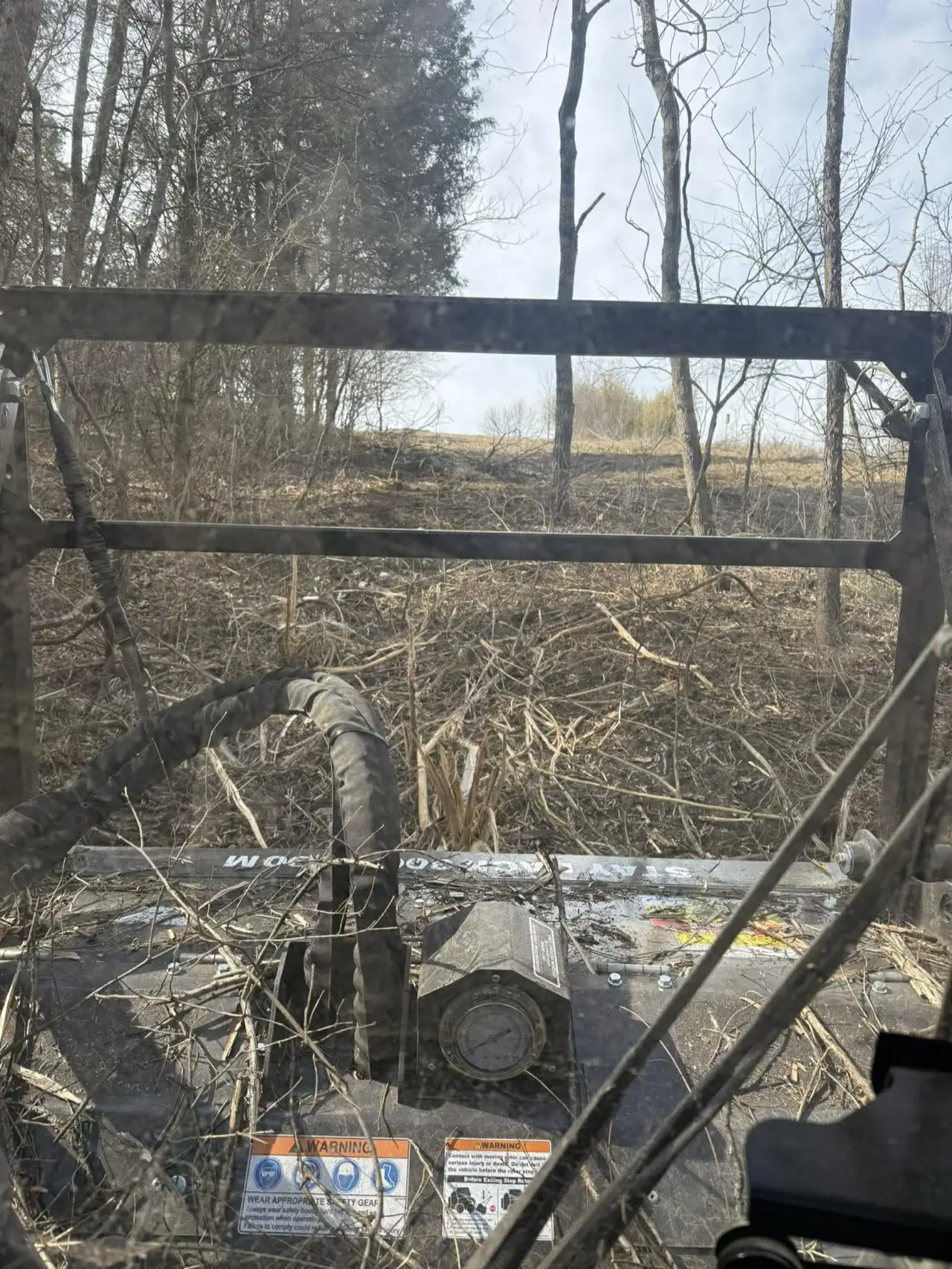
Forestry mulching uses a single machine with a high-speed rotating drum to grind standing trees, brush, and stumps into mulch in one pass. The mulching head spins at 2,000+ RPM, shredding vegetation into small chips that are left on the ground as a natural erosion barrier. It handles trees up to 8–12 inches in diameter and leaves topsoil undisturbed.
What Is Forestry Mulching, Exactly?
Forestry mulching is a land clearing method that uses one machine to cut, grind, and spread vegetation in a single pass. No chainsaw crews. No burn piles. No dump trucks hauling debris away. Everything that was standing on your property gets ground into mulch and left on the surface.
The concept is simple even if the equipment is not. A tracked machine — picture something that looks like an oversized skid steer on tank treads — carries a mulching head on a hydraulic arm. That mulching head has a steel drum covered in carbide-tipped teeth spinning at high speed. Drive the machine into a thicket of brush and saplings, lower the head, and the drum grinds everything it touches into chips. Walk the machine forward, and what was an impenetrable wall of honeysuckle and cedar becomes a flat carpet of wood chips in about the time it takes to describe it.
We run a CAT mulcher pushing over 300 horsepower. That matters because horsepower is what determines how thick a tree the machine can chew through without stalling. Under-powered machines bog down on anything over 4–5 inches. Ours handles 8-inch trees at full walking speed and can push through 10–12 inch stems with a slower approach.
The Equipment: More Than Just a Big Mower
The Carrier Machine
Our primary mulcher is a tracked carrier — not wheeled. Tracks spread the machine's weight over a larger surface area, which means less ground pressure and fewer ruts on your property. This is a big deal in Northern Kentucky where our clay soils turn into a slippery mess after any rain. A wheeled machine would tear the ground apart. Tracks float over it.
The carrier weighs roughly 20,000 pounds. It has a fully enclosed cab with bulletproof-rated polycarbonate windows. That last part is not a joke. When the mulching head sends a piece of wood sideways at 150 mph, you want something between it and your face.
The Mulching Head
This is where the work happens. The mulching head is a hydraulically driven drum, about 5 feet wide, covered in rows of replaceable carbide teeth. Each tooth is a hardened steel block with a tungsten carbide tip — the same material used in mining drill bits. We go through teeth regularly. A single day of heavy mulching can wear down a full set.
The drum spins at roughly 2,000–2,500 RPM. At that speed, the teeth don't so much cut vegetation as shatter it. Wood fibers get ripped apart at the cellular level, which is why the resulting mulch is fine and decomposes quickly. A chainsaw cuts a clean surface that resists rot. A mulcher creates thousands of fractured surfaces that bacteria and fungi colonize immediately.
The head mounts on a hydraulic boom that can raise, lower, tilt, and swing. This matters for uneven ground. We can keep the drum at a consistent height even when the terrain rolls, which means an even cut across the whole pass.
Support Equipment
On most jobs, the mulcher is all we need. But bigger projects sometimes call for a chainsaw crew to pre-cut trees over 12 inches before the mulcher comes through. We also carry a stump grinder for jobs where clients need stumps taken below grade level. The mulcher grinds stumps flush with the ground, but if you are building a foundation, you need them lower than that.
The Process: Start to Finish
Step 1: Site Walk and Planning
Before we fire up the mulcher, we walk the property. Every time. We are looking for hazards the machine cannot handle — buried utilities, old well casings, metal fencing, large rocks at the surface. We also mark any trees the landowner wants to keep. It is surprisingly easy to lose a tree you meant to save when you are clearing everything around it, so we flag keepers with orange tape and give them a buffer.
We check the ground conditions. If it rained two days ago and the clay is saturated, we might wait. Mulching on wet clay creates ruts that take years to smooth out. We would rather reschedule than leave your property looking like a mud pit.
Step 2: Establish Access
The mulcher has to get from the trailer to the work area. Sometimes there is a clear path. Sometimes we have to cut our way in. On a recent job in Grant County, the only access to a back 10 acres was a narrow dirt track that had grown over with multiflora rose on both sides. We spent the first hour mulching a path wide enough for the machine to travel safely. That is billable time, but it has to happen.
Step 3: The Actual Mulching
This is the part people show up to watch. We work in systematic passes, usually starting at one edge and moving across the property in strips. The mulching head swings back and forth as the machine moves forward, grinding everything in its path.
Light brush — saplings under 4 inches, honeysuckle, privet, autumn olive — disappears almost instantly. The machine barely slows down. A thick stand of 3-inch cedars might as well be tall grass.
Medium trees in the 4–8 inch range take a bit more effort. We approach the tree, lower the head onto the trunk, and let the drum grind through it. An 8-inch hackberry takes maybe 15–20 seconds. The trunk gets chewed from the top down, then we grind the stump flush.
For trees in the 8–12 inch range, the process is slower. We might make multiple passes, grinding the trunk section by section rather than trying to eat it all at once. The machine can do it, but forcing it wastes teeth and burns fuel. Patience is cheaper than new carbide.
Trees over 12 inches are outside the practical range for our mulcher. We can nibble at them, but it is not efficient and it is hard on the equipment. Anything that size, we bring a saw crew first.
Step 4: Stump Treatment
After the standing vegetation is gone, we go back over the stumps. The mulching head grinds them down to ground level or slightly below — usually 2–4 inches into the soil. This is enough for pasture, trails, food plots, and most landscaping. If you are pouring a slab or building a house, you will need dedicated stump grinding to go deeper. We are upfront about that.
Step 5: Cleanup Pass
We do a final pass over the cleared area to catch anything we missed and to spread the mulch layer evenly. The finished product is a uniform carpet of wood chips, typically 2–4 inches deep. Underneath that mulch layer, the soil is intact — no ruts, no exposed subsoil, no erosion channels. The root systems are still in the ground holding things together, which matters a lot on slopes.
What the Ground Looks Like After
People are always surprised by how clean it looks. Before mulching: an impenetrable mess of brush and trees. After: an open area covered in a layer of wood chips, with scattered stumps ground flush to the surface. You can walk across it immediately. Within a few months, grass starts growing through the mulch layer.
The mulch itself is a mix of wood chips, bark, and leaf material. It ranges from fine shredded fiber to chunks about the size of a playing card. Over one to two growing seasons, it breaks down into the soil and enriches it. We have cleared properties in Boone County where the landowner came back a year later and said the grass was growing better on the mulched areas than anywhere else on the property. That is the organic matter doing its thing.
What Forestry Mulching Can Handle
- Trees up to 8 inches in diameter at full speed
- Trees up to 10–12 inches with a slower approach and multiple passes
- Saplings, brush, and scrub of any density
- Invasive species — honeysuckle, multiflora rose, autumn olive, privet, bush honeysuckle, Bradford pear
- Stumps ground to at or just below ground level
- Thorny vegetation like locust, osage orange, and blackberry
- Fallen trees and deadwood
- Tall weeds and grass (though a brush hog is cheaper for open fields)
What Forestry Mulching Cannot Handle
Knowing the limits matters. We would rather tell you upfront than surprise you on the job.
- Trees over 12 inches in diameter — Not impossible, but impractical. The time and tooth wear make it uneconomical. Pre-cut with a chainsaw first.
- Rock and stone — Limestone, sandstone, large rocks. One rock hit can crack a tooth or damage the drum housing. We need to know about surface rock before we start.
- Metal — Old fencing, wire, T-posts, barbed wire buried in trees. Metal destroys teeth instantly. If your property has old fencing, it needs to come out before we mulch. We have hit fence wire that was grown into a tree 6 feet off the ground. That is not something you can always see coming.
- Concrete and masonry — Old foundations, poured slabs, block walls.
- Steep slopes over 30 degrees — The machine can work slopes up to about 25–30 degrees. Beyond that, it is a safety issue. Some hillsides in Campbell and Pendleton counties are simply too steep for the equipment.
- Standing water or swamp — The tracks will sink. If your low area holds water, we work around it or wait for dry conditions.
How Long Does It Take?
Speed depends on vegetation density and terrain. Here is what a typical day looks like:
| Vegetation Type | Acres Per Day | Notes |
|---|---|---|
| Light brush and saplings | 3–5 acres | Fastest work, machine barely slows |
| Medium brush with 4–8" trees | 1.5–3 acres | Most common job type |
| Heavy growth with 8–12" trees | 0.5–1.5 acres | Requires multiple passes |
A typical residential job — say, 2 acres of medium brush behind a house in Burlington — takes one full day. A 10-acre farm clearing in Grant County might take three to four days. We give timeline estimates during the site visit that are usually accurate within half a day.
Why One Machine Beats the Traditional Approach
The old way to clear land involves a chainsaw crew, a bulldozer, a burn pile, and sometimes a dump truck. That is four operations, multiple pieces of equipment, and a week or more of work for what a mulcher does in a day or two.
The traditional approach also strips topsoil. A dozer blade scrapes the organic layer right off the ground and pushes it into a pile with everything else. What you are left with is exposed subsoil — the dead clay underneath. Nothing grows in that easily. You end up spending money on topsoil, grading, and seeding to fix what the dozer broke.
Mulching keeps the topsoil in place. The root systems stay in the ground and continue to hold the soil together. The mulch layer protects the surface from rain impact and erosion. On slopes, this is not a minor detail — it is the difference between a stable hillside and a mud slide after the next heavy rain.
That said, mulching is not always the right choice. If you are doing full site prep for construction and need every root out of the ground, a dozer and excavator combination is the right tool. We are happy to tell you when that is the case.
Conditions That Affect the Process
Wet ground is our biggest enemy. Northern Kentucky clay holds water like a sponge, and a 20,000-pound machine will leave ruts in saturated soil that are difficult to fix. We watch the weather forecast and postpone when we need to. In our experience, two dry days after rain is usually enough on flat ground. Slopes need longer.
Frozen ground is actually ideal. Winter mulching on frozen soil leaves virtually no trace of the machine. The ground is like concrete. We can work in areas that would be a muddy disaster in April.
Tall, dense honeysuckle can be tricky not because the machine cannot handle it, but because you cannot see what is inside the thicket. We have driven into honeysuckle walls and found old car bodies, well casings, and abandoned equipment. We take it slow in blind vegetation.
What Happens to the Mulch Over Time
The mulch layer starts breaking down immediately. Fungi colonize the wood chips within weeks. By the end of the first summer, the layer has settled and thinned. By the following spring, grass is growing through it. Within two years, most of the mulch has decomposed into the soil.
On slopes, the mulch layer is a genuine erosion control benefit. It absorbs rain impact, slows water flow, and holds soil particles in place. We have watched properties through heavy spring rains after mulching and seen zero washout where the mulch layer was intact.
If you want grass established faster, you can seed directly into the mulch layer. We recommend a seed-and-straw application 2–4 weeks after mulching. For pricing details, see our forestry mulching cost guide. The mulch holds moisture, which helps germination. Some of the best hay fields we have seen in Pendleton County started as mulched woodland.
Related Services
We Serve These Areas
How Forestry Mulching Works: The Complete Process Explained FAQ
A forestry mulcher uses a tracked carrier machine with a rotating drum covered in carbide-tipped teeth spinning at 2,000+ RPM. The drum grinds standing trees, brush, and stumps into mulch in a single pass. The mulch is left on the ground as a natural layer that decomposes over 1–2 years.
Our forestry mulcher handles trees up to 8 inches in diameter at full speed and can process trees up to 10–12 inches with multiple passes. Trees larger than 12 inches should be pre-cut with a chainsaw before mulching for efficiency and equipment safety.
No. Forestry mulching is one of the least disruptive clearing methods. The topsoil stays intact, root systems remain in the ground to prevent erosion, and the mulch layer protects the surface. Tracked machines spread weight to minimize ground pressure and rutting.
Light brush and saplings can be mulched at 3–5 acres per day. Medium vegetation with trees up to 8 inches takes about 1.5–3 acres per day. Heavy growth with larger trees may only cover 0.5–1.5 acres per day. Terrain and access also affect speed.
The mulch layer, typically 2–4 inches deep, begins decomposing within weeks. Grass grows through it within one growing season, and most of the material is fully broken down into the soil within two years. It improves soil fertility and provides effective erosion control in the meantime.
Ready to Get Started?
Free on-site estimates for all properties in our service area.
Ready to Clear Your Land?
Get a free, no-obligation estimate for your project. We respond fast and show up on time.
Try our cost calculator · Serving Northern Kentucky, Greater Cincinnati, and Southeast Indiana · 24/7 — Emergency Service Available