
Forestry Mulching for Homeowners: What You Need to Know Before Hiring
A homeowner-friendly guide to forestry mulching — what the process looks like, what it costs on a typical NKY half-acre lot, and how to avoid hiring the wrong contractor.
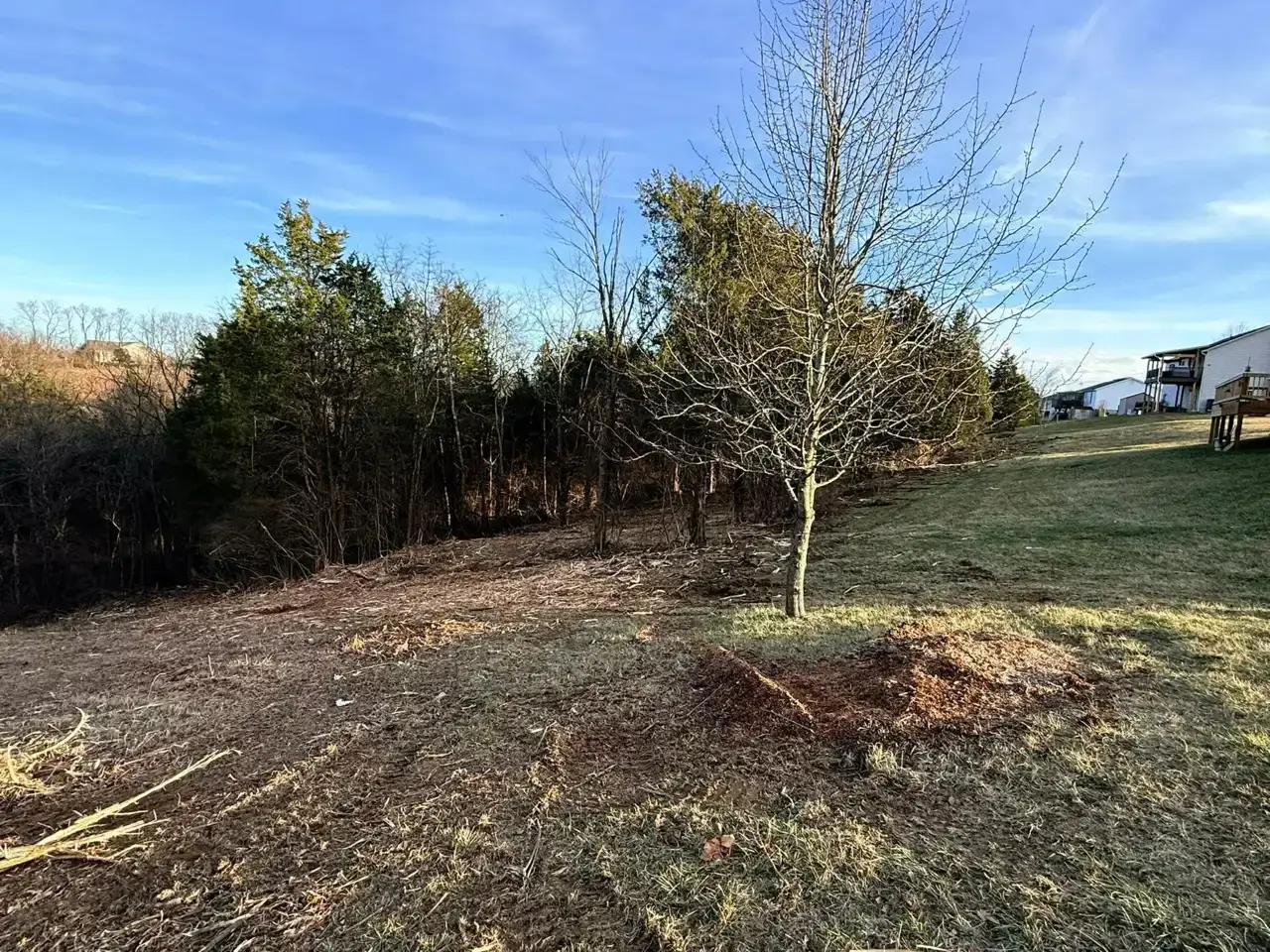
Forestry mulching for homeowners typically costs $1,200–$3,500 for a half-acre residential lot in Northern Kentucky. The process takes one day for most lots. Ask contractors about insurance, equipment size, and cleanup expectations before hiring. Get at least two on-site estimates rather than phone quotes.
What Forestry Mulching Actually Is (Plain English)
If you've never hired a land clearing contractor, the phrase "forestry mulching" probably means nothing to you. That's fine. Here's the short version: a machine with a rotating drum full of steel teeth drives through your property and grinds up trees, brush, and vegetation right where they stand. Everything gets turned into a layer of mulch on the ground. No burn piles. No dump trucks hauling stuff away. No exposed dirt.
The machine looks like a skid steer or small bulldozer with a drum attachment on the front. It's loud. It's messy while it's working. And when it leaves, your overgrown back lot looks like a park with a nice layer of wood chips on the ground.
We run these machines across Northern Kentucky and Greater Cincinnati six days a week. Most homeowners who call us are dealing with the same thing: a section of their property that's gotten away from them, and they want it back.
Why Homeowners Call Us
In our experience, about 80% of residential forestry mulching calls fall into one of these categories:
- Overgrown back lot or side yard — The area behind the fence that hasn't been touched in 5–10 years. Honeysuckle, privet, wild grape, saplings everywhere.
- New home purchase with wooded area — You bought the house and the back acre is a jungle. You want usable space.
- Preparing for a fence, shed, or outbuilding — Need to clear a section before the next contractor can start.
- Neighbor complaints or HOA pressure — The overgrowth is creeping onto the neighbor's lot or violating community standards.
- Tick and pest control — Clearing brush creates a buffer zone that dramatically reduces tick habitat near your home.
If any of that sounds familiar, you're in the right place.
What It Costs for a Typical NKY Home
I'll give you real numbers. A typical half-acre residential lot in Boone or Kenton County with moderate overgrowth — honeysuckle, small trees under 6 inches, assorted brush — runs $1,500 to $2,800. That includes mobilization, the actual mulching, and cleanup of the work area.
Quarter-acre lots start around $1,200 because we have a minimum charge to cover getting the equipment to your property. Doesn't matter if the job takes two hours of actual cutting. The trailer still has to roll.
| Lot Size | Vegetation Level | Typical Cost |
|---|---|---|
| Quarter acre | Light brush/honeysuckle | $1,200–$1,800 |
| Half acre | Moderate brush, small trees | $1,500–$2,800 |
| Half acre | Heavy trees 6–10" | $2,500–$3,500 |
| Full acre | Mixed vegetation | $2,000–$4,000 |
These are 2025 prices for our service area — Florence, Burlington, Independence, Hebron, Union, and surrounding areas. If you're in Mason or West Chester on the Ohio side, add a bit for the longer drive.
What to Expect on the Day
Here's what a typical residential job looks like, start to finish.
Morning arrival. We show up with the mulcher on a trailer, usually between 7:30 and 8:00 AM. We need space to park a truck and trailer — your driveway or the street works. We'll walk the property with you one more time to confirm what's being cleared and what's staying.
Setup takes about 30 minutes. Unloading the machine, checking the work area, making sure we know where utilities run.
The mulching is loud. Fair warning. Tell your neighbors. It sounds like an industrial wood chipper running nonstop. Most half-acre jobs take 3–5 hours of actual mulching time.
Cleanup. We don't leave debris outside the work area. Any mulch that gets thrown onto your lawn or driveway gets blown or raked back. The cleared area will have a 2–4 inch layer of wood chip mulch across it. That's normal. It decomposes over a few months.
We're usually done and gone by mid-afternoon on a standard residential lot. Bigger or heavily wooded lots might carry into a second day, but we'll tell you that during the estimate.
Questions to Ask Before You Hire Anyone
I'm going to give you the list I'd want if I were hiring a contractor for the first time. These questions separate good operators from guys who rented a machine last week.
Insurance
"Do you carry general liability and do you have equipment insurance?" This is non-negotiable. A forestry mulcher can throw rocks, debris, and wood chunks. If a piece of wood goes through your window or hits your car, you want the contractor's insurance covering it — not yours. Ask for a certificate of insurance. Any legitimate company will provide one without hesitation.
Equipment
"What machine do you run?" A real forestry mulching outfit has a dedicated mulching head on a tracked machine or large skid steer. Some guys try to do this work with a brush cutter attachment on a regular skid steer. That's a different tool for a different job. It won't handle anything over about 3 inches in diameter and leaves a rough result.
Experience in Residential Settings
"Have you worked in neighborhoods before?" Working near houses, fences, and utility lines is different from clearing an open field. You want someone who understands that the neighbor's fence is 4 feet from the property line and that there's a gas meter on the side of the house. We work in subdivisions in Florence and Burlington regularly. It requires more care than open land.
Cleanup Expectations
"What does the property look like when you're done?" Some contractors mulch and leave. The work area is done, but mulch debris is scattered on your lawn and driveway. We clean up after ourselves, but you should ask because not everyone does.
Utility Location
"Have you called 811?" Or more accurately, have they reminded YOU to call 811? Underground utility locates are required before any ground-disturbing work in Kentucky and Ohio. It's free and takes a few days. If a contractor says they don't bother with that, walk away.
Red Flags to Watch For
After doing this work for years across NKY, we've heard the stories. Here's what should make you nervous:
- Phone-only quotes with no site visit. Nobody can accurately quote a mulching job from a phone call or a Google Earth screenshot. If they won't come look at it, they're guessing. You'll either overpay or get a surprise bill.
- No insurance documentation. "Yeah, we're insured" isn't documentation. Ask for the certificate.
- Way below market pricing. If everyone's quoting $2,000–$2,500 and one guy says $800, something is off. Either the equipment isn't right, the insurance doesn't exist, or the scope doesn't match.
- Pressure to decide immediately. "This price is only good today" is a sales tactic, not a business practice. A real quote stands for 30 days minimum.
- No written contract or scope of work. You want the clearing area, the price, the timeline, and what's included all written down before work starts.
What Forestry Mulching Won't Do
I'd rather tell you the limitations upfront than have you disappointed after the fact.
- It won't remove stumps below ground. The mulcher cuts stumps at or just below ground level. If you're pouring a concrete slab or building a foundation, you'll need stump grinding as a separate step.
- It won't grade or level the ground. The terrain stays the same. If there were bumps and dips before, there will be bumps and dips after — just without the trees.
- It won't prevent regrowth permanently. Invasive species like honeysuckle and autumn olive will resprout from the roots. A herbicide follow-up 6–8 weeks after mulching is the only way to kill the root systems. We can do this for you, but it's a separate service.
- It won't handle very large trees. Our equipment handles trees up to about 8–10 inches in diameter. That 24-inch oak tree at the back of your lot? That needs a chainsaw and probably a tree service, not a mulcher.
Honest take: forestry mulching is the best tool for overgrown brush and small-to-medium trees on residential lots. It is not the right tool for every situation. If a different approach makes more sense for your property, we'll tell you.
After the Mulching: What to Do Next
The mulch layer on the ground is a good thing. It suppresses weed growth, retains moisture, and breaks down into organic matter that feeds the soil. Leave it in place if you can.
If you want grass, you can seed directly over thin mulch areas. Where the mulch is thicker (over 3 inches), either rake it to the sides or wait a season for it to break down. Kentucky fescue and bluegrass both establish well in the fall after a spring or summer mulching job.
If you had invasive species, schedule the herbicide follow-up. This is the step most homeowners skip, and it's the step that matters most for long-term results. Six weeks after mulching, the invasives send up new sprouts from the root systems. That's when they're most vulnerable to treatment. Skip this, and you'll be looking at regrowth within two years.
How to Get Started
Call us at (859) 710-6107 or fill out the form on our website. We'll ask a few questions — address, approximate area, what's growing there — and schedule a time to walk the property. Estimates are free and we don't do the hard-sell thing. We'll tell you what we'd recommend, what it costs, and how soon we can get to it.
Most residential jobs in NKY can be scheduled within 2–3 weeks during normal months. Spring (March through May) is our busiest season, so plan ahead if you've got a deadline.
Related Services
We Serve These Areas
Forestry Mulching for Homeowners: What You Need to Know Before Hiring FAQ
A half-acre residential lot with moderate brush and small trees typically costs $1,500–$2,800 in Northern Kentucky. Heavier vegetation with larger trees can push costs to $3,500. There is usually a minimum charge of $1,200 regardless of lot size to cover equipment mobilization.
Most residential lots (half acre to one acre) are completed in a single day. The actual mulching takes 3–5 hours, with setup and cleanup adding about an hour on each end. Larger or heavily wooded lots may carry into a second day.
A professional operator will stay within the work area and clean up any debris that lands on your lawn or driveway. The tracked machine can leave minor impressions on soft ground, but a skilled contractor minimizes this. Dry weather and frozen ground conditions produce the least impact.
You do not need to be present during the work, but we recommend being available for the initial walkthrough when the crew arrives. This is when we confirm exactly what is being cleared and what is being preserved. After that, we can work independently.
Wood mulch on the ground does not attract termites to your home. Termites are already present in soil throughout Northern Kentucky. Keep mulch at least 6–12 inches away from your home foundation as a standard precaution, which applies to any type of mulch including store-bought landscape mulch.
Ready to Get Started?
Free on-site estimates for all properties in our service area.
Ready to Clear Your Land?
Get a free, no-obligation estimate for your project. We respond fast and show up on time.
Try our cost calculator · Serving Northern Kentucky, Greater Cincinnati, and Southeast Indiana · 24/7 — Emergency Service Available